


Ball Sort - Color Puzzle Game
SATORISYS PLAY
I went into Ball Sort - Color Puzzle Game expecting a simple time-filler, and that is exactly where it succeeds. It is a casual puzzle game built around arranging colored balls into matching tubes, with the kind of rules you can understand almost immediately. The appeal is not a large story, a complicated progression system, or a long list of modes. It is the small satisfaction of seeing a messy arrangement become orderly one move at a time.
That simplicity makes it easy to recommend in the right situation. I can imagine opening it while waiting for an appointment, taking a short break from work, or winding down without wanting to learn a new control scheme. At the same time, players looking for action, narrative, competition, or a deep puzzle campaign may find it too narrow. My overall view is that this is a focused, approachable color-sorting game whose value depends on whether you enjoy quiet, repeatable problem-solving.
How the color-sorting puzzle feels in everyday play
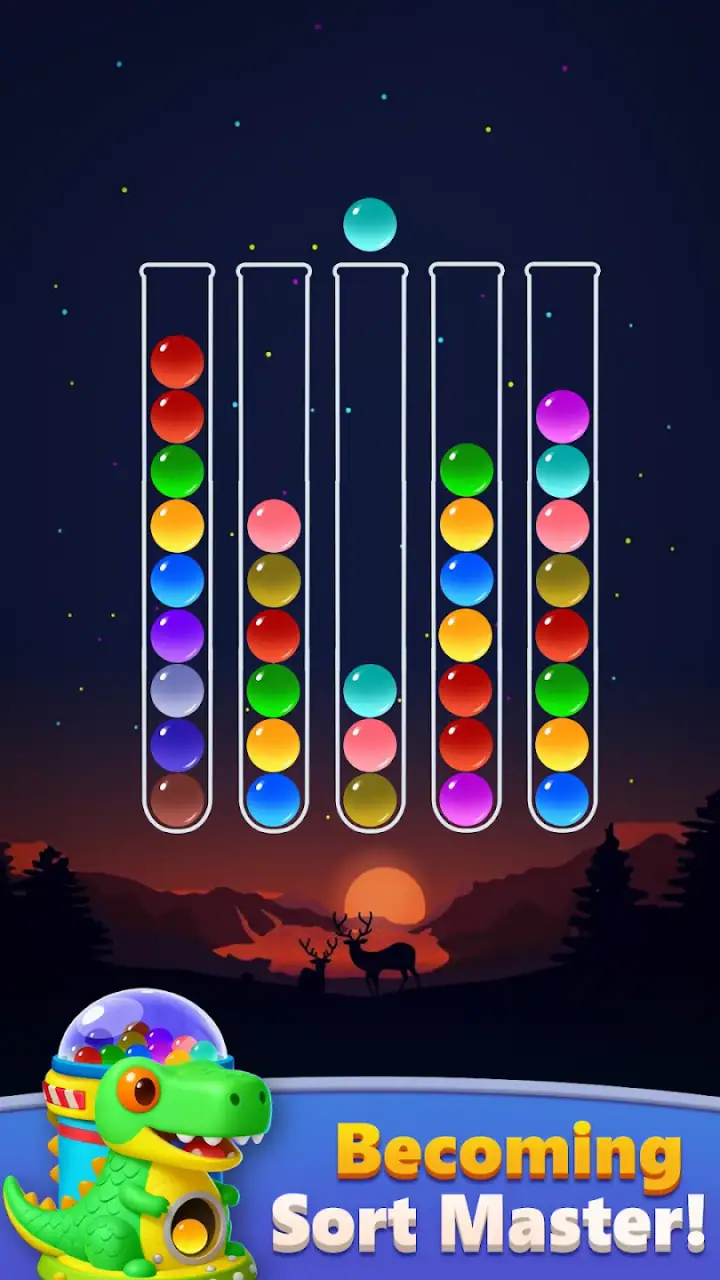
The central task is familiar: move balls between containers until each container holds a single color. The challenge comes from limited space and the need to avoid blocking the colors you still need. A move that looks helpful in the moment can leave the next color buried, so even the early decisions reward a little planning rather than random tapping.
I like that the rules are readable without a tutorial-heavy introduction. The colored balls communicate the goal directly, and the container layout gives each puzzle a clear visual structure. This matters on a phone because casual games work best when I can understand the board at a glance. Here, the screen is doing most of the explaining.
The first useful habit is to stop treating every empty container as an invitation to move something into it. An empty space is valuable because it gives you flexibility. I usually look for a color that is blocking another color, then consider whether moving it creates a useful chain of actions. Preserving room for temporary storage is often more important than completing one color immediately.
Related News






A second habit is to identify the most restricted color before making a move. If one color has only a small number of reachable positions, I deal with that situation first. This prevents the common mistake of building a neat-looking stack that later becomes impossible to rearrange. The game feels more satisfying when I solve it through these small observations rather than by trying moves at random.
That makes the experience suitable for short sessions, but it also gives it a quiet mental rhythm. I can play quickly when the arrangement is obvious, or pause over a crowded board when several possible moves compete. There is no need to memorize a complicated control layout. The thinking is entirely about order, space, and consequences.
Why the simple format works so well
The strongest part of this game is its low barrier to entry. Someone who rarely plays mobile games can understand the objective after seeing the board for a moment. Someone who already enjoys sorting puzzles can start looking for more efficient solutions right away. That broad accessibility is reflected in its Everyone content rating, which fits the gentle presentation and straightforward concept.
Gallery
It is also free to play, so trying it does not require a purchase decision before I know whether the format suits me. The game comes from SATORISYS PLAY, and its presentation stays centered on the puzzle rather than trying to turn a small idea into something unnecessarily elaborate. For a player who wants a quick casual distraction, that restraint is a strength.
One practical advantage is that the game can fit around interruptions. If I have only a few minutes, I can work through a simple board and stop. If a more demanding arrangement appears, I can put the phone down and return to the same visual problem when I have more attention. That makes it more flexible than many casual games that depend on a continuous round or fast reactions.
The sorting mechanic can also be useful as a low-pressure reset between tasks. After reading, commuting, or handling repetitive work, a short puzzle gives my attention one concrete problem to solve. I would not call it a productivity tool, but it can serve as a small mental change of pace without asking for the commitment of a full game session.
Another detail I appreciate is that the challenge comes from the arrangement itself rather than from learning a character, map, or upgrade system. That keeps the focus on the decision in front of me. If I fail to solve a board efficiently, the lesson is usually visible: I used space poorly, moved a blocking ball too late, or committed to a stack before checking the rest of the layout.
Where it compares favorably with other casual puzzles
Compared with match-three games, this is much less dependent on quick pattern recognition and chain reactions. I am not waiting for a lucky combination or trying to react before the board changes. Every move feels more deliberate. Players who prefer calm planning may enjoy that difference, while fans of flashing effects and constant rewards may find it subdued.
Compared with word puzzles, it avoids language barriers. The colors and positions carry the meaning, so the basic activity is accessible even when a player does not want to read much. That also makes it a reasonable choice for a shared device used by different age groups, provided everyone is comfortable distinguishing the colors on the screen.
Compared with larger logic games, however, the format is narrower. A sudoku app, nonogram game, or physics puzzle can offer a wider variety of reasoning styles. Ball sorting stays with one core idea. I see that as a benefit when I want consistency, but it is a limitation when I need novelty or a more substantial campaign.
The game’s strongest comparison is probably with other tube-sorting titles. It offers the familiar pleasure of organizing a cluttered board without adding a complicated ruleset. That makes it easy to pick up, but it also means the experience depends heavily on how much I enjoy repeating variations of the same mental exercise. It is focused rather than broad.
The friction that affects long-term enjoyment
The main weakness is also the natural consequence of its design: repetition can arrive sooner than some players expect. Once I understand the sorting logic, the basic action remains the same. New arrangements can still test my planning, but the emotional range is limited compared with games that add new mechanics, stories, characters, or changing objectives.
I would therefore be cautious about recommending it as a primary game for someone who wants a long, evolving experience. It works better as a dependable side game. I can open it for a brief puzzle, enjoy the feeling of progress, and leave without feeling that I have missed a major event or fallen behind a competitive group.
There is also a trade-off between accessibility and depth. Because the rules are so easy to grasp, the game does not ask me to learn a complex system. That is excellent for casual use, yet experienced puzzle players may eventually want more demanding variations than the basic sorting structure provides. If your enjoyment comes from discovering entirely new mechanics, this may feel limited.
Color is central to the experience, so visual clarity matters more here than it would in a text-based puzzle. I found myself relying on both the ball colors and their positions, but anyone who has difficulty distinguishing similar shades should consider whether the board remains comfortable to read. This is not a criticism of the concept so much as an important audience consideration: the game’s central information is visual and color-led.
The game can also punish hurried play in a way that feels slightly frustrating when I am treating it as a mindless distraction. A careless move may reduce the available space and force me to rethink the board. That is fair within the puzzle, but it means the game is not entirely passive. Even a short session rewards attention, especially when the containers are crowded.
My practical solution is to slow down before the first move. I scan the top visible balls, note which colors can be completed soon, and reserve at least one useful space for rearrangement. This small pause makes the boards feel less trial-and-error driven. It also turns the game from simple tapping into a compact planning exercise, which is where most of its lasting value lies.
Small strategies that make the puzzles more enjoyable
When I am stuck, I do not immediately undo every recent action. I first inspect whether the problem came from using the wrong temporary container or from exposing a color too early. Reversing the most recent move can hide the real issue. Looking at the whole arrangement often reveals that an earlier decision created the bottleneck.
I also avoid completing a color simply because I can. A finished container is useful, but the move may consume a position that another color needs as a temporary landing place. The better question is not “Can I finish this stack?” but “Will finishing it leave enough room for the remaining colors?” That distinction is one of the clearest ways to improve at this type of puzzle.
Another useful approach is to separate safe moves from speculative ones. A safe move places a ball onto the same color without reducing future options. A speculative move uses empty space to uncover information or create access. I try the safe moves first, then use speculative moves only when they open a clear route. This keeps the board manageable and reduces unnecessary reshuffling.
For a short everyday session, I prefer solving one board with full attention rather than tapping through several puzzles while distracted. The game is more relaxing when I let the visual order emerge gradually. If I am tired, I choose the obvious moves and stop when the board starts requiring too much concentration. That makes it a better break than an obligation to keep playing.
Parents and families may also find the basic concept approachable because it does not depend on combat or complicated objectives. Still, I would play alongside a younger child at first, not because the premise is difficult, but because planning several moves ahead can be less obvious than the colorful presentation suggests. The game looks simple, yet the best solutions require patience.
Who should install it, and who should skip it
I think it is a good fit for people who like organizing tasks, visual logic, and calm mobile sessions. If you enjoy arranging objects, solving small spatial problems, or finding the cleanest route through a restricted layout, the ball-and-tube format has enough structure to keep you engaged. It is especially convenient for players who want something they can understand immediately.
It is also suitable for someone choosing a first puzzle game. The basic objective is approachable, the controls are direct, and the casual category accurately describes the experience. The free price removes the need to make a large commitment, while the Everyone rating makes it easier to consider for a broad household audience.
I would skip it if your ideal mobile game needs a strong story, expressive characters, real-time competition, or a wide selection of activities. I would also look elsewhere if you quickly tire of repeated sorting challenges. A broader puzzle collection would give you more variety, while an action-oriented game would provide faster feedback and more immediate excitement.
For older phones, the listed minimum operating-system requirement is Android 7.1, so anyone using an older Android device should check compatibility before planning around it. On supported devices, the current version is 1.1.0. Those details are useful when deciding whether the game belongs on a spare phone or a family device, especially if that device is not updated regularly.
The game has built a visible audience, with over one hundred thousand installs and an average rating of 4.7 from around six thousand ratings. I treat those figures as encouraging rather than conclusive: they suggest the uncomplicated format is working for many players, but personal taste still matters more than popularity when the entire experience revolves around one mechanic.
My verdict after spending time with the sorting boards
Ball Sort - Color Puzzle Game is at its best when I treat it as a small, focused thinking break. It does not need a story or elaborate systems to make a single board satisfying. The pleasure comes from preserving space, revealing the right color at the right time, and watching an untidy arrangement become complete through careful choices.
Its limitations are clear. The repeated structure may not hold the attention of players who need constant novelty, and the color-centered presentation may not suit everyone. It also asks for more focus than its casual appearance initially suggests. Those are meaningful trade-offs, not reasons to dismiss it; they simply define the kind of player who will get the most from it.
For me, the best recommendation is specific: install it if you want a free, approachable sorting puzzle for short sessions and enjoy planning several moves ahead. Keep looking if you want a varied puzzle library, a narrative adventure, or a game that changes dramatically over time. As a compact casual title from SATORISYS PLAY, it earns its place through clarity and easy access rather than ambition—and that is precisely why it can work so well in the right moment.
FAQs for Ball Sort - Color Puzzle Game
What is Ball Sort - Color Puzzle Game?
Ball Sort - Color Puzzle Game is a casual sorting puzzle in which you move colored balls between tubes until every tube contains balls of only one color. The rules are simple, but the difficulty increases as more colors, tubes, and complicated arrangements are introduced. It is designed for short sessions, although some levels require careful planning and several moves ahead.
How do you play Ball Sort - Color Puzzle Game?
To play, tap a tube to pick up its top ball, then tap another tube to pour it there. You can usually move a ball only onto an empty tube or onto a ball of the same color, and the destination must have enough space. The objective is to organize all matching colors into separate tubes without running out of useful moves.
Is Ball Sort - Color Puzzle Game free to download and play?
The game is generally available as a free download, allowing players to access its main sorting levels without paying upfront. However, free versions may include advertisements, optional purchases, or paid features such as removing ads, receiving hints, undoing mistakes, or unlocking additional content. Check the store listing for the current pricing and in-app purchase details.
Does Ball Sort - Color Puzzle Game work offline?
Many of the core puzzles can usually be played without a constant internet connection, which makes the game convenient for travel, commuting, or quick breaks. An internet connection may still be required for advertisements, analytics, cloud features, updates, or purchases. Offline availability can vary by version and device, so confirm the latest store information before downloading.
Is Ball Sort - Color Puzzle Game suitable for children and beginners?
The game is easy to understand and does not normally require advanced reading or gaming experience, making it approachable for beginners and older children. Nevertheless, later levels can become surprisingly challenging and may encourage trial and error. Parents should also review advertising, privacy, and in-app purchase settings, especially if the application will be used by younger players.
Pros
- Simple rules make it easy to start playing immediately.
- Smooth controls make moving colored balls feel precise.
- Levels gradually introduce more challenging arrangements.
- Works well for short sessions during commutes or breaks.
- Minimal design keeps attention focused on solving puzzles.
Cons
- Some later levels may feel repetitive after extended play.
- Undo moves or extra tubes may require limited in-game resources.
- Ads can interrupt the experience between puzzle attempts.
- Mistakes may force players to restart difficult arrangements.
- The game offers little variety beyond its core sorting mechanic.


